5 Viral Airport Security ‘Hacks’ Put to the Test
Social media platforms like TikTok, Instagram Reels, and YouTube Shorts are filled with influencers claiming to have found genius loopholes in airport security rules.
From freezing water bottles solid to beat the 3-1-1 liquid rule, to cramming clothes into a pillowcase to skip $65 budget airline carry-on fees, these “hacks” rack up tens of millions of views. But what actually happens when you try them in front of a federal TSA officer or an airline gate agent?
We analyzed official FAA regulations, Title 49 CFR security mandates, and airline contract of carriage policies to test the 5 most viral travel hacks.
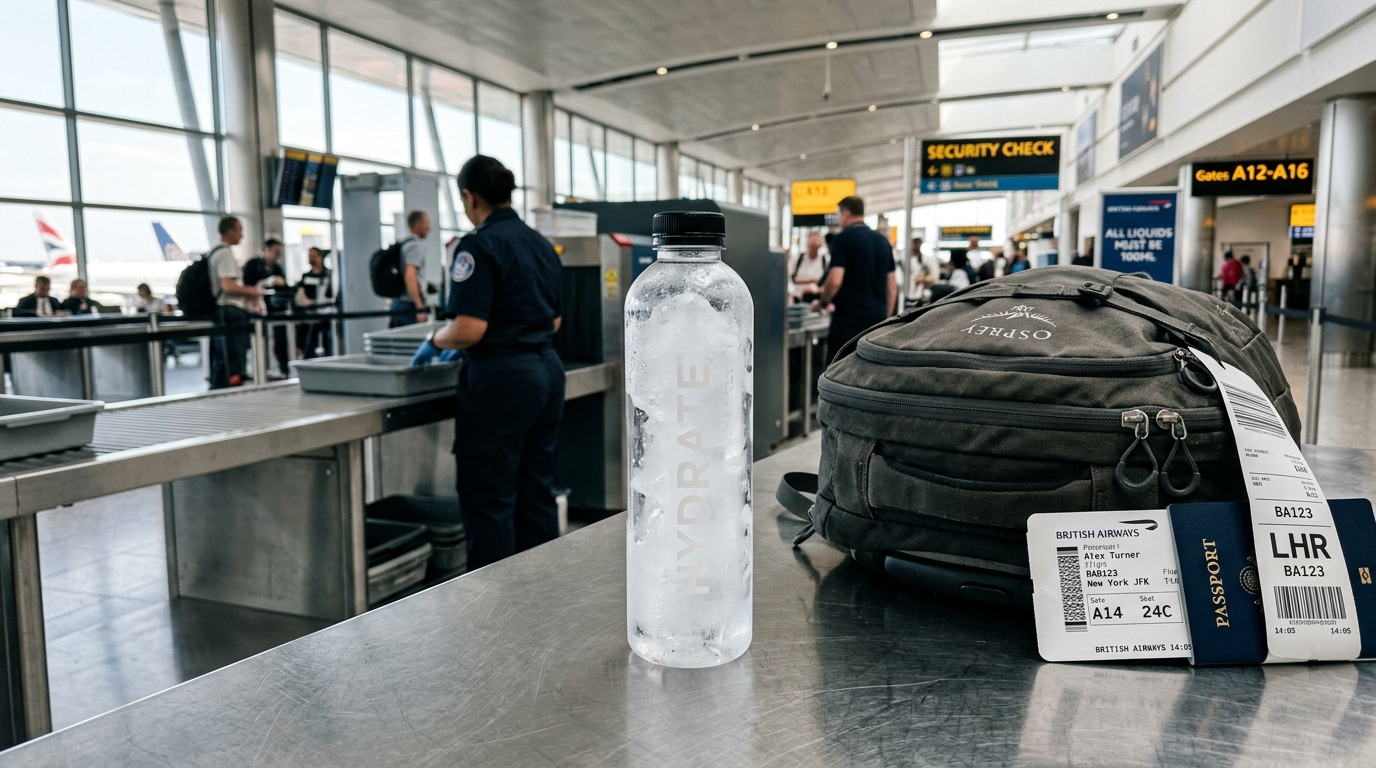
Hack #1: The “Frozen Water Bottle” 3-1-1 Loopholes
The Claim: If you freeze a full bottle of water completely solid before leaving for the airport, it is classified as a solid rather than a liquid, allowing you to pass checkpoint security without violating the 3.4-ounce limit.
Does It Legally Work?
Technically YES — but practically HIGH RISK.
According to official TSA checkpoint guidelines:
[!NOTE] Official TSA Liquid Rule on Frozen Items:
“Frozen liquid items are allowed through the checkpoint as long as they are frozen solid when presented for screening. If frozen liquid items are partially melted, slushy, or have any liquid at the bottom of the container, they must meet 3-1-1 requirements.”
What Actually Happens at Security:
If you live 20 minutes from the airport and travel in winter, your bottle might arrive 100% frozen solid. The TSA X-ray scanner will read the dense crystal matrix of ice as a solid block and pass it through.
However, if you hit highway traffic, stand in a 45-minute security line, or travel on a warm day, even a single teaspoon (5 ml) of melted water pooling at the bottom of the bottle invalidates the entire container. The officer will instruct you to either drink the liquid on the spot, dump it, or surrender the bottle.
- Verdict: ✅ REAL RULE, ⚠️ HIGH CHANCE OF FAILURE. It’s far safer to bring an empty reusable bottle and fill it at airport water refill stations past security.
Hack #2: The “Pillowcase Luggage” Hack
The Claim: Stuff three days of sweaters, socks, and jeans into a standard zippered bed pillowcase, and carry it onto budget airlines (Ryanair, Frontier, Spirit, EasyJet) as a “comfort item” that doesn’t count toward baggage fees.
Does It Work?
❌ NO (Airlines are actively cracking down in 2026).
While this hack went viral with travelers saving hundreds of dollars in 2022 and 2023, global airlines quickly amended their Conditions of Carriage:
- Gate Agent Scrutiny: Gate agents for ultra-low-cost carriers are trained to inspect pillows. If a pillow feels unusually firm, lumpy, or contains a visible zipper, agents have the contractual right to require the passenger to compress it into the baggage sizing box or pay an oversized gate bag fee ($60 to $100).
- Safety Regulations: FAA emergency egress rules require personal items and carry-on luggage to fit entirely under the seat in front of you or in the overhead bin. A pillow filled with bulky clothes cannot be safely squeezed onto a passenger’s lap during takeoff and landing.
- Verdict: ❌ BUSTED. Gate agents on budget carriers are actively intercepting pillowcase packers and charging full gate check fees.
Hack #3: The “Duty-Free Shopping Bag” Free Carry-On Loophole
The Claim: Buy something tiny at an airport duty-free shop, get their large tamper-evident plastic shopping bag, and stuff your excess personal belongings inside it. Airlines cannot charge you for duty-free airport purchases.
Does It Work?
✅ YES on most European & International flights, ⚠️ CONDITIONAL in the US.
Under European Civil Aviation Conference (ECAC) and UK Department for Transport rules, airport concession and duty-free bags are explicitly exempt from standard one-bag cabin baggage limits at boarding gates.
In the United States, however, federal regulations state that airlines determine cabin baggage allowances. While legacy carriers (Delta, American, United) routinely look past a duty-free bag, ultra-low-cost carriers (Frontier, Spirit, Allegiant) strictly enforce a maximum of 2 items total (1 carry-on + 1 personal item), and will charge you if you carry a third bag, regardless of where the shopping bag came from.
- Verdict: ✅ WORKS on international/EU flights; ⚠️ CHECK your airline’s specific gate baggage terms on US ultra-budget carriers.
Hack #4: Wearing 8 Layers of Clothes to Avoid Baggage Weight Limits
The Claim: Put on 3 hoodies, 2 jackets, 2 pairs of jeans, and multiple shirts to lower your suitcase weight below the airline’s 15 lb / 22 lb carry-on limit.
Does It Work?
⚠️ RISKY — Triggers Checkpoint Delays.
At the airline check-in desk, agents cannot weigh what is on your body. But at the TSA or airport security body scanner, this hack causes severe issues:
- Millimeter Wave Scanner Alarms: Advanced Imaging Technology (AIT) body scanners detect bulky or layered fabric folds as anomalies. Thick layered clothing triggers alarms across your chest, arms, and back.
- Mandatory Secondary Pat-Down: You will be pulled aside for an extensive manual pat-down and potentially a private screening room inspection.
- Removal Requirements: Security officers will instruct you to remove all outer layers, bulky sweaters, and jackets, sending them through the X-ray scanner anyway.
- Verdict: ⚠️ WORKS for airline check-in weight limits, but creates huge security checkpoint delays.
Hack #5: The “STEB Bag” Liquid Duty-Free Connecting Flight Rule
The Claim: You can carry full-size bottles of perfume or liquor on connecting flights, even through domestic TSA checkpoints, as long as they are sealed in a specific airport bag.
Does It Work?
✅ 100% TRUE (Officially Protected by TSA Regulations).
Many passengers lose expensive duty-free wine or cologne because they assume connecting US flights enforce the 3.4-ounce limit with zero exceptions.
Under the Secure Tamper-Evident Bag (STEB) program:
-
Liquids over 3.4 oz purchased at duty-free airport stores or on international flights are allowed through US checkpoints on connecting itineraries.
-
The liquid must be sealed in an official transparent, tamper-evident bag with the original receipt clearly visible showing it was purchased within the last 48 hours.
-
The TSA officer will inspect the bag and run it through a specialized Bottle Liquid Scanner (BLS).
-
Verdict: ✅ OFFICIALLY VERIFIED. Keep the seal completely unbroken until you arrive at your final destination.
Summary of Viral Travel Hacks
| Travel Hack | Feasibility | Regulatory Standing | Risk Level |
|---|---|---|---|
| Frozen Solid Water Bottle | Conditional | Official TSA Exception | High (if 1 drop melts) |
| Pillowcase Clothes Stuffer | Busted | Airline Policy Ban | High ($60+ gate fee) |
| Duty-Free Airport Bag | Mostly True | ECAC / Airline Policy | Medium on US budget airlines |
| Wearing Extreme Layers | Inconvenient | TSA Security Alarm | High (triggers full pat-down) |
| STEB Sealed Duty-Free Liquids | Confirmed | Official 49 CFR Rule | Low (must stay factory sealed) |