7 Secret TSA Checkpoint Exemptions Most Passengers Don’t Know About
Nearly every flyer knows the basic drill: take off your shoes, remove your laptop, and pack all liquids into 3.4-ounce (100 ml) bottles inside a single quart-sized clear zip-top bag.
What most travelers do not know is that federal aviation regulations contain multiple formal legal exemptions to the 3-1-1 liquids rule and standard screening requirements. Because these exceptions are not heavily advertised on airport signage, passengers frequently throw away expensive contact lens solution, baby formula, prescription liquids, and perishable medications unnecessarily.
Here are the 7 official, legally binding TSA checkpoint exemptions that every traveler should know before packing their carry-on bags.
1. Medically Necessary Liquids Over 3.4 oz (100 ml)
Under Title 49 CFR § 1544.219, medically necessary liquids, gels, and aerosols are completely exempt from both the 3.4-ounce volume limit and the quart-sized bag requirement.
What Qualifies:
- Prescription liquid medications, syrups, and inhalers.
- Over-the-counter liquid medications (pain relievers, cough syrups, allergy liquid).
- Contact Lens Solution: Even full-sized 12-ounce bottles of sterile saline and contact solution are classified as over-the-counter medical liquids.
- Eye drops, ear drops, and nasal sprays.
- Medically required liquid nutrition, electrolytes, and glucose gels.
How to Screen It:
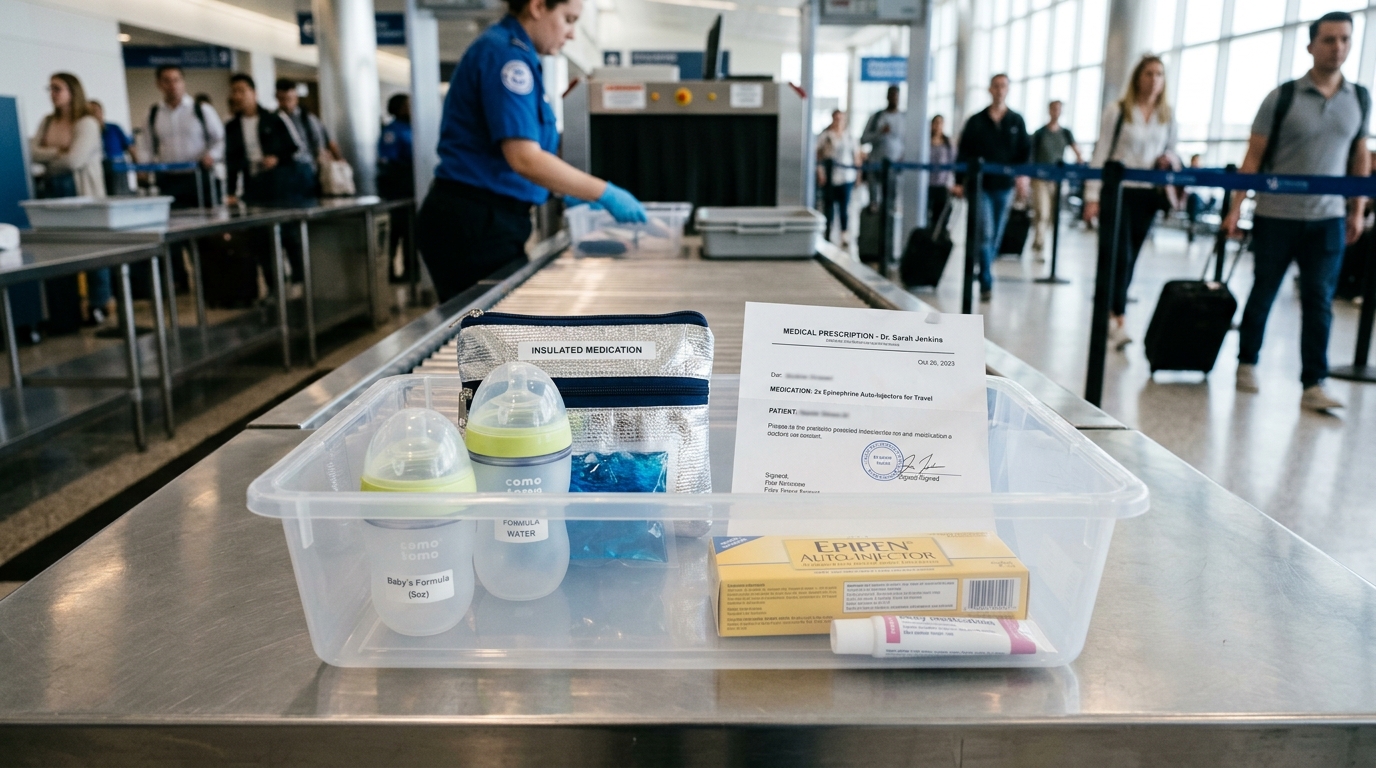
You do not need to squeeze these items into your 3-1-1 quart bag. Before your bag enters the X-ray scanner, simply remove the medical liquids, inform the TSA officer that you are traveling with medically necessary liquids, and present them in a separate bin for visual and chemical vapor screening. A doctor’s prescription note is helpful but not legally required under federal guidelines.
2. Baby Formula, Breast Milk & Toddler Juices
Parents traveling with infants and toddlers enjoy one of the broadest exemptions in commercial aviation.
- Formula and Breast Milk: Permitted in “reasonable quantities” well exceeding 3.4 ounces.
- Child Presence Not Required: You do not need to have the infant or child traveling with you to transport expressed breast milk or formula through the checkpoint.
- Purified Water for Mixing: You are allowed to carry bottles of water through the checkpoint if they are specifically intended for mixing powdered infant formula.
- Purees and Teething Gel: Baby food pouches, teething creams, and toddler smoothies are permitted in quantities suitable for the duration of travel.
Inform the TSA officer at the start of the lane. Officers will test the exterior of the bottles using vapor or liquid bottle scanners without touching or contaminating the liquid inside.
3. Ice Packs, Freezer Packs & Gel Packs for Medical & Nursing Needs
Normally, liquid or gel freezer packs must be 100% frozen solid to pass through security. However, there is a crucial medical exemption:
- If an ice pack or gel pack is being used to keep medically necessary medication (such as insulin, biologic injectables, or growth hormones) or infant formula/breast milk cold, it is permitted through checkpoint screening even if partially melted or fully liquid.
- Standard non-medical ice packs (used for soda cans or sandwiches) that have begun to melt will still be rejected under the general 3-1-1 rule.
4. Seniors (75+) and Children (Under 12) Shoe & Jacket Exemptions
If you do not have TSA PreCheck, you are normally required to remove your shoes, light jackets, and belts. But federal policy grants automated PreCheck-style privileges to specific age demographics:
- Passengers 75 Years and Older: Are permitted to leave their shoes and light jackets on during screening. If the walk-through detector alarms, a shoe swab or visual inspection is performed rather than requiring shoe removal.
- Children 12 Years and Younger: Do not have to remove shoes or light jackets and are permitted to walk through standard metal detectors with their parents.
5. Duty-Free Alcohol & Fragrances on Connecting Flights (STEB Exemption)
If you are flying internationally into the United States and have a domestic connecting flight (for example, London Heathrow → JFK → Atlanta):
- Normally, after clearing US Customs and Border Protection (CBP) at your first port of entry, you must re-clear TSA security before boarding your connecting domestic flight.
- If you purchased full-size liquor, wine, or cosmetics at the duty-free shop abroad, they are permitted in your carry-on bag through the domestic TSA checkpoint, provided they remain sealed inside an official Secure Tamper-Evident Bag (STEB) with the original itemized receipt visible from the last 48 hours.
6. TSA Cares & Sunflower Lanyard Program for Hidden Disabilities
Travelers with medical conditions, mobility challenges, autism spectrum disorders, sensory sensitivities, or invisible disabilities do not have to endure standard security stress.
- TSA Cares Dedicated Passenger Support: You can contact the TSA Cares helpline (1-855-787-2227) at least 72 hours prior to your flight to arrange a dedicated Passenger Support Specialist (PSS).
- An officer will meet you before the security checkpoint, guide you through an accessible screening lane, and coordinate private screening if requested.
- The internationally recognized Hidden Disabilities Sunflower Lanyard is officially recognized at major US airports, signaling to staff that you may need additional time, clearer instructions, or accommodation.
7. Biological and Prosthetic Devices
Travelers with insulin pumps, continuous glucose monitors (CGMs), pacemakers, bone growth stimulators, or prosthetic limbs are legally protected:
- No Mandatory X-Ray for Sensitive Medical Devices: Continuous glucose monitors (Dexcom, Freestyle Libre) and insulin pumps can be damaged by full-body millimeter wave scanners and X-ray luggage belts.
- Under TSA protocols, you have the right to request a manual hand-check and pat-down instead of walking through body scanners or putting delicate medical transmitters through X-ray tunnels.
- Never remove insulin pumps or prosthetics for screening.
Summary of Essential TSA Exemptions
| Category | Standard TSA Rule | Legal Exemption | How to Claim |
|---|---|---|---|
| Medical Liquids | Max 3.4 oz in quart bag | Any reasonable size allowed | Declare verbally to officer before scanning |
| Contact Solution | Max 3.4 oz | Full size 12 oz bottles permitted | Declare as medical liquid |
| Baby Formula / Milk | 3-1-1 restriction | Unlimited reasonable travel volume | Remove from bag for separate bottle scan |
| Medication Ice Packs | Must be 100% frozen solid | Allowed even if melted | Must accompany medical items or milk |
| Seniors (75+) & Kids (12-) | Shoes off at scanner | Shoes and light jackets stay ON | Automatic based on age |
| Duty-Free Sealed STEB | Prohibited over 3.4 oz | Permitted on US connections | Keep sealed in tamper-evident bag |
| Diabetic Tech / CGMs | Must undergo standard scan | Alternative hand inspection allowed | Request hand-check before scanner entry |