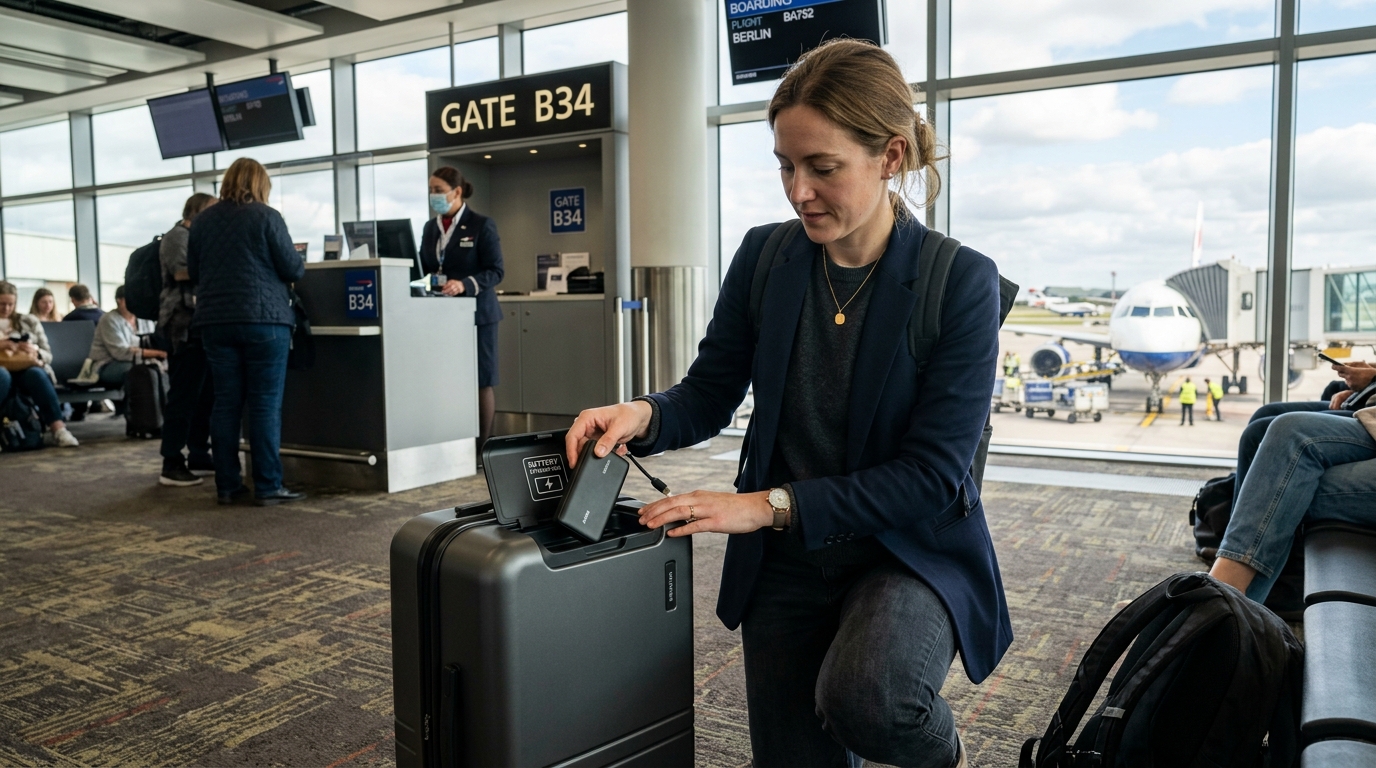
Why Smart Luggage Is Getting Banned at Boarding Gates
High-tech suitcases with integrated USB charging ports, motorized ride-on wheels, digital scale handles, and GPS location tracking were marketed as the future of effortless travel.
Yet in 2026, thousands of airline passengers are experiencing the nightmare of being stopped at boarding doors and told their expensive smart luggage cannot be loaded onto the plane under any circumstances.
Why are major airlines (Delta, American, United, British Airways, Lufthansa, Emirates) clamping down on smart bags? It all comes down to federal aviation safety directives regarding lithium-ion batteries in cargo holds.
Here is what makes a smart bag illegal to fly with, the essential rules for carry-on versus checked bags, and how to verify your suitcase before arriving at the airport.
The Core Aviation Rule: The Removable Battery Mandate
Under joint regulations issued by the FAA (Federal Aviation Administration), EASA (European Union Aviation Safety Agency), and IATA (International Air Transport Association):
[!IMPORTANT] Global Airline Smart Luggage Policy:
Smart bags powered by lithium-ion batteries are only permitted if the battery is completely removable by the passenger. If the battery is permanently built-in and cannot be disconnected without specialized workshop tools, the bag is strictly prohibited from both checked baggage AND cabin luggage.
Why Aviation Authorities Ban Non-Removable Batteries:
Lithium-ion batteries carry a risk of thermal runaway—a chemical reaction where damaged or short-circuited battery cells overheat uncontrollably, catching fire and releasing toxic gases.
- In the Passenger Cabin: Flight crews are equipped with thermal containment fire bags, fire extinguishers, and protective gear to rapidly douse battery fires.
- In the Cargo Hold: The aircraft belly contains automated halon fire suppression systems. However, halon gas cannot easily extinguish the high-temperature chemical fires generated by runaway lithium battery cells. An uncontained fire in a cargo compartment can compromise aircraft hull integrity within minutes.
Because overhead bins routinely fill up on busy flights, gate agents frequently force passengers to “gate-check” carry-on bags into the belly of the plane. If your smart bag has a non-removable battery, it cannot legally enter the cargo hold, leaving gate agents with no choice but to refuse the bag entirely.
Carry-On vs Checked Luggage: How to Fly with Smart Bags
If you own a smart suitcase (such as Away, Monos, July, or Samsara), here is exactly how to pack and travel with it:
1. If You Are Checking Your Smart Bag
- Step 1: Disconnect and remove the lithium power bank from the bag prior to dropping it off at the check-in desk.
- Step 2: Bring the removed power bank with you into the cabin in your personal item or backpack.
- Step 3: The empty suitcase shell travels safely in the cargo hold.
2. If You Are Carrying the Bag into the Cabin
- Most airlines allow you to leave the removable battery connected while the bag is in the passenger cabin.
- CRITICAL GATE WARNING: If the flight is full and gate staff announce that all roller carry-ons must be checked at the boarding bridge, you must instantly remove the power bank and bring it onto the aircraft seat with you.
Motorized Ride-On Suitcases: The New Strict Ban
Ride-on motorized suitcases (such as Airwheel, Modobag, or SE3) became a viral trend on social media, with travelers cruising through terminals at 8 mph.
However, in 2026, international airlines have introduced strict bans on ride-on motorized luggage:
- Massive Battery Watt-Hours: Most motorized ride-on suitcases use heavy lithium battery packs rated between 180 Wh and 250 Wh.
- Under FAA and airline regulations, the absolute upper limit for any lithium-ion battery on a commercial flight is 100 Wh (or up to 160 Wh with prior written airline approval).
- Any device exceeding 160 Wh is classified as Dangerous Goods Freight and cannot be transported on passenger aircraft under any circumstances.
- As a result, ride-on motorized suitcases are banned from passenger travel across almost all global carriers.
Smart Luggage Checklist: Is Your Bag Permitted?
Before you pack for your next flight, check these four specifications:
| Feature | Permitted Status | Condition |
|---|---|---|
| Removable Lithium Battery (≤ 100 Wh) | ✅ ALLOWED | Must be carried in cabin if bag is checked |
| Non-Removable Lithium Battery | ❌ PROHIBITED | Banned on almost all commercial airlines |
| Bluetooth Trackers (AirTags, Tiles) | ✅ ALLOWED | Safe in both cabin and checked bags |
| Built-in Digital Weight Scale (CR2032/AAA) | ✅ ALLOWED | Coin cells and alkaline batteries are safe |
| Motorized Ride-On Suitcases (> 100 Wh) | ❌ PROHIBITED | Exceeds legal passenger battery capacity |
What to Do If Stopped at the Boarding Gate
If an airline gate agent questions your smart carry-on:
- Demonstrate the Release Mechanism: Show the agent that your bag features an external quick-release button or compartment allowing the battery to eject in under 5 seconds.
- Remove the Power Bank Immediately: Do not argue about whether the bag will fit in the overhead bin. Eject the battery pack, slide it into your pocket or personal handbag, and hand the bag to the ground crew for gate-checking.
- Carry Backup Charging Cables: Keep standard USB-C and Lightning cables in your small personal item so you can still charge your phone from your removed power bank during the flight.