Why TSA Considers Peanut Butter a Liquid
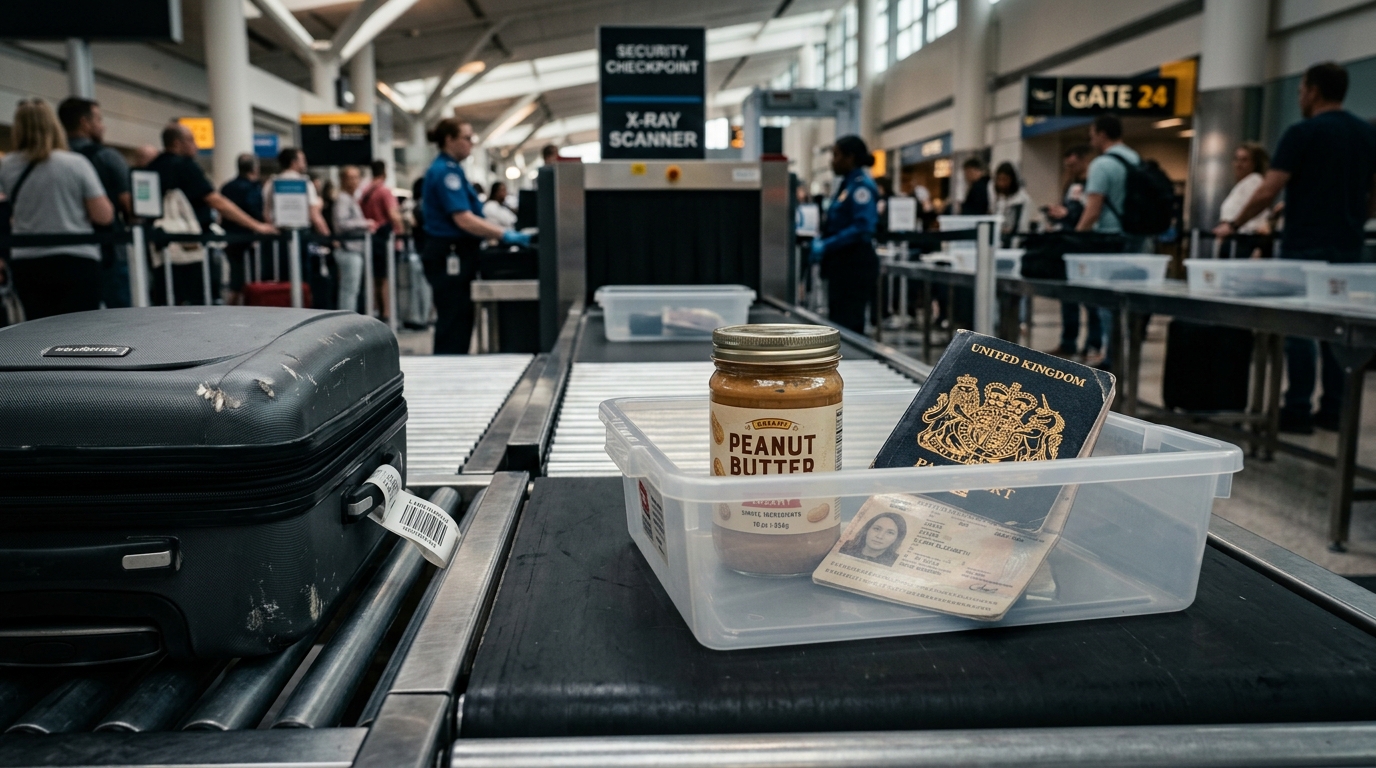
Few things ignite more airport checkpoint outrage than watching a TSA officer pull a brand-new, unopened 16-ounce jar of creamy peanut butter from your carry-on bag and deposit it into the hazardous disposal bin.
To any reasonable human being, peanut butter is a solid spread. It does not flow like water, it does not spill if you tip the jar upside down, and it sits calmly on toast. Yet under Federal Transportation Security Administration (TSA) regulations, peanut butter is officially classified as a liquid, gel, or aerosol (LGA).
If your jar exceeds the standard 3.4-ounce (100 ml) container limit, it is strictly banned from carry-on luggage.
Here is the science, the exact aviation regulations, the infamous “sandwich loophole,” and how to travel with peanut butter without losing it at the scanner.
The Official TSA Definition: The “Container Rule”
In March 2023, the TSA posted a viral statement across its official social media channels that sparked national debate:
[!NOTE] Official TSA Ruling:
“You may not be chewing on this, but a liquid has no definite shape and takes a shape to dictate its container. Peanut butter is a liquid! Packing a full jar? Place it in your checked bag.”
Under Title 49 of the Code of Federal Regulations (49 CFR § 1540.111), aviation security rules do not use culinary or nutritional definitions of liquids. Instead, airport screeners follow an operational physical definition:
- If an item can be spilled, spread, sprayed, pumped, or poured, it falls under the 3-1-1 Liquids Rule.
- If a substance conforms to the shape of its container over time or under gentle pressure, the X-ray detection algorithms classify its mass density similarly to liquid explosives.
Because creamy and crunchy peanut butter both spread and conform to the container, TSA checkpoints categorize them alongside toothpaste, shampoo, sunscreen, and hummus.
Liquids, Gels, and Aerosols: What Else Counts as a “Liquid”?
Travelers are regularly surprised by the sheer number of pantry foods that the TSA categorizes as liquids:
| Food Item | TSA Classification | Carry-On Rule | Checked Bag Rule |
|---|---|---|---|
| Peanut Butter | Gel / Spread | Max 3.4 oz in clear quart bag | ALLOWED (Any size) |
| Nutella / Chocolate Spread | Gel / Spread | Max 3.4 oz | ALLOWED |
| Hummus & Dips | Gel / Spread | Max 3.4 oz | ALLOWED |
| Honey & Maple Syrup | Viscous Liquid | Max 3.4 oz | ALLOWED |
| Jam & Jelly | Gel | Max 3.4 oz | ALLOWED |
| Soft Cheeses (Brie, Camembert) | Paste / Gel | Max 3.4 oz | ALLOWED |
| Hard Cheeses (Cheddar, Parmesan) | Solid Food | ALLOWED (No limit) | ALLOWED |
| Peanut Butter Sandwiches | Solid Composite | ALLOWED (Any quantity) | ALLOWED |
Why Airport Scanners Flag Peanut Butter
There is an authentic security rationale behind why TSA X-ray scanners stop jars of peanut butter:
- Organic Density Signatures: Computed Tomography (CT) and dual-energy X-ray checkpoint machines measure the effective atomic number ($Z_{eff}$) and mass density of materials. Peanut butter is an organic substance rich in hydrocarbons, fats, and moisture—a density profile that closely mimics certain nitro-methane or organic plastic explosives.
- Container Concealment: An opaque jar filled with dense spread makes it impossible for legacy checkpoint scanners to view what is hidden in the center of the jar without opening it.
- Screening Bottlenecks: Opening and testing paste foods with chemical trace swabs causes checkpoint delays. To maintain terminal flow, federal regulations enforce a hard 3.4-ounce cap on all paste substances.
The Infamous “Sandwich Loophole”
Here is the irony that makes the peanut butter rule go viral across travel forums:
- A 12-oz jar of peanut butter: ❌ Confiscated at checkpoint.
- A dozen peanut butter and jelly sandwiches: ✅ ALLOWED with zero restrictions.
Once peanut butter is spread onto slices of bread, it ceases to be a containerized spread and becomes a solid composite food item.
TSA officers will allow you to bring through an entire bag of peanut butter sandwiches, bagels with peanut butter, or protein bars made with peanut butter. As long as the food is not stored as a loose paste in a tub or jar, it passes standard carry-on inspection.
4 Ways to Fly with Peanut Butter Without Losing It
If you depend on peanut butter for dietary needs, hiking fuel, or traveling with children:
1. Buy Single-Serve 1.15 oz Squeeze Packets
Major brands (Justin’s, Jif To Go, RXBAR) sell individual 1.15 oz (32g) squeeze packs. These fall well below the 3.4 oz limit. You can pack multiple packets inside your single quart-sized clear liquids bag.
2. Put It in Checked Luggage
There is zero quantity or volume restriction on peanut butter in checked baggage. Wrap your jars in a sealed zip-top bag to prevent pressure changes at 35,000 feet from popping the seal.
3. Powdered Peanut Butter (PB2)
Powdered peanut butter is classified as a solid powder. Under TSA rules, powders under 12 oz (350 ml) pass without issue. You simply mix it with bottled water after clearing the security checkpoint.
4. Spread It Ahead of Time
Prepare your sandwiches, rice cakes, or celery sticks before heading to the airport. Solid food travels with zero liquid restrictions.
Frequently Asked Questions
Can I bring crunchy peanut butter through TSA?
No. Both crunchy and creamy peanut butter are categorized identically under 49 CFR § 1540.111. The peanut pieces do not alter the classification of the surrounding paste.
What happens if TSA pulls my peanut butter at security?
The officer will give you three choices:
- Surrender the jar for disposal.
- Step out of the security line and check your bag at the ticket counter (if time permits).
- Eat as much as you can before re-entering the security checkpoint.
Does TSA PreCheck exempt peanut butter?
No. TSA PreCheck allows you to leave your quart-sized liquids bag inside your carry-on, but it does not increase the 3.4-ounce volume threshold. An oversized jar in a PreCheck lane will still be intercepted and confiscated.